
Dublin Central Library: Being curious is essential to the librarian’s role
This week we hear from Dublin Central Library:
Tucked away in the heart of the city on Henry Street is the Central Library, Dublin City’s busiest and largest library with a daily footfall of 1400. Serving a diverse and multi-cultural community, the library was initially developed to replace the former central lending library on Capel Street and will celebrate 40 years of library provision in 2026
As part of a wider network of libraries, the Central Library plays a key role in promoting the concept of lifelong learning by offering a range of opportunities to develop skills, learn new things and meet others in the community.
Serving the community requires an inclusive approach to those who may not consider themselves readers or the stereotypical library members. “I think the most important first step in encouraging reading among non-readers is to be a welcoming and inclusive space that offers a lot of things that people need outside of ‘traditional’ or ‘core’ library services like lending books,” said divisional librarian David O’Brien.
“We offer laptop-lending, acoustic sound booths and podcasting studios alongside resources that make reading really accessible, such as large print books, audiobooks and materials in multiple languages. We run a varied program of events and workshops from author talks and book clubs to creative writing sessions.
“Our staff are experienced in directing those who might lack confidence to the right materials for them to develop or grow their relationship with reading. For children, we have storytime sessions and summer reading challenges to get them excited about books from an early age.”

Dublin Central Library children’s area.
Access plays a huge role in reaching non-traditional library members. According to O’Brien, citizens of Dublin can be no further than 5 kilometres from their nearest public library, which means mobile libraries like those used in other places are not required. But that doesn’t mean that everyone comes into the library.
Outreach is conducted in two ways: events and collections, overseen by the Library in the Community department. “This section exemplifies the best practices of community engagement by meeting communities ‘where they are at’, listening to their needs, and adapting the library service to meet those needs,” said O’Brien. The Library in the Community department facilitated 228 events and engaged with 19,793 people in 2024.
Events include pop-up libraries, information sessions, membership drives, and demonstrations of online library resources, 3D virtual library tours, storytelling, and cultural events for both adults and children.
Success is measured in more than audience numbers. “Sometimes events have smaller audiences, but it is still important that they are held. Sometimes success is a small number of people who get a lot from a talk. For example, a recent talk on ‘Supporting your autistic child’ had about 8 people attending rather than 25, but the facilitator reported that the group members, who mostly hadn’t known each other beforehand, really bonded with a huge amount of information and experiences shared. The event ran about an hour over time, had rave reviews and the facilitator was very happy to have spread information to [what they find] a difficult-to-reach cohort,” said O’Brien.
There are over 80 outreach collections throughout the city, which are carefully curated and placed in locations in the community where people have difficulty accessing their local library branch – for example, hospitals, nursing homes, homeless services, women’s shelters, health centres, older persons housing complexes, and youth clubs. The team also introduced Acorn Age Friendly tablets for lending to people who cannot physically visit their local library.
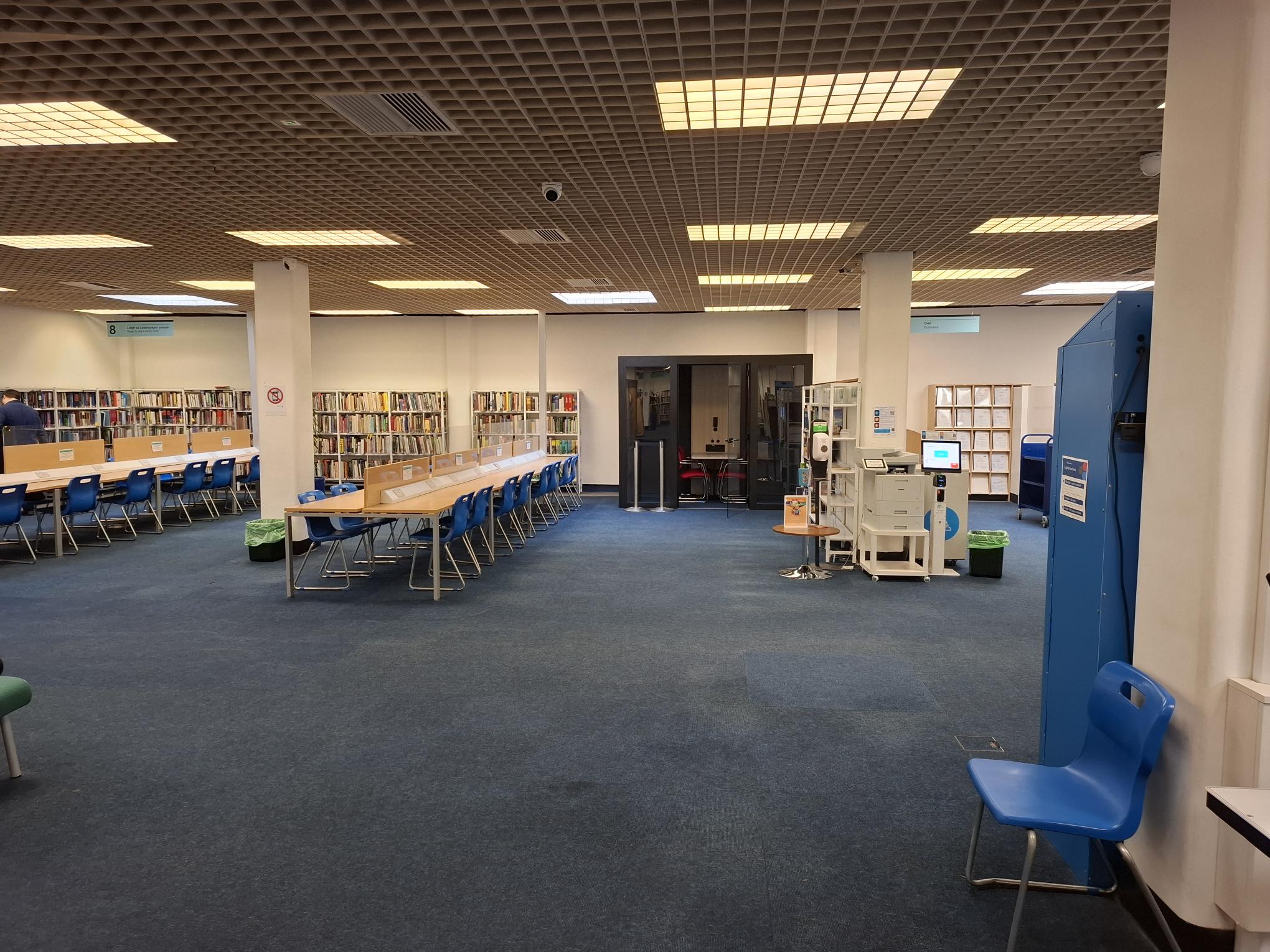
Dublin Central Library’s work stations.
Dublin City Libraries also provides a home delivery service. In 2024, there were 347 home deliveries, an increase of 23% from 2023.
The library also runs reading initiatives like “One Dublin, One Book”, a city-wide reading campaign each April, now in its 20th year. As part of the broad goals of the program, two emerging writers have been selected – Rónán Hession’s book Leonard and Hungry Paul (RH Adult) and Louise Nealon’s Snowflake (Manilla) – which “puts them into focus by readers and publishers”, said O’Brien.
Partnerships form a clear strategy in supporting Dublin City Libraries’ community.
To further support creative writers in the city, the library works closely with the Dublin UNESCO City of Literature office, located on Pearse Street.
The library’s first anthology project, Dublin in the Coming Times, was a city-wide writing initiative set up in 2017 that invited participants to imagine the “city of the future”. Published as a collection of fantasy short stories, the anthology features writers of all ages, backgrounds, and experience levels. The second anthology, Knock and Enter, published in 2022, comprised poetry and short stories written by writers meeting in libraries.
The Dublin City Libraries and City of Literature office have also partnered with the Irish Writers Centre to administer the National Mentoring Programme. The scheme pairs three emerging writers with experienced, published writers to work on a literary project. To date, 12 writers and poets have benefitted from this mentoring scheme.
“I think what I have learned (or at least what has stuck with me the most over the years) is that there is no ‘one size fits all approach’ to catering to patrons’ needs while also trying to maintain relevance and integrity in a constantly evolving environment,” said O’Brien. “It is okay to try things that don’t work out and we shouldn’t feel too disheartened when they do. What is important is that we keep moving forward, keep innovating but also keep listening.
“Being curious is essential to the role of a librarian in so many ways. It helps us respond effectively and productively when facing problems that we might not have anticipated and can also help us to be resilient when facing the challenges that being a public servant can bring.”
Category: Features