Muurrbay: Seeding a publishing ecosystem in Aboriginal Languages
Celebrating 40 years in 2026, the Muurrbay Aboriginal Language and Culture Co-operative is a regional language centre with offices on Gumbaynggirr Country (Nambucca Heads) and Warrimay Country (Raymond Terrace) in New South Wales. In this article, PhD researcher Jodie Lea Martire and Muurrbay Elder in Residence Uncle Gary Williams (Gumbaynggirr/Bundjalung) share with Books+Publishing about this language centre’s “unsung success story of Australian publishing”.
Muurrbay aims to support East Coast Aboriginal Peoples “to learn, teach and revitalise their language and culture”, including the vital work of publishing. Muurrbay’s publishing work is a not-for-profit venture, as the language centre is funded by the Australian Government Indigenous Languages and Arts program.
A long, proud publishing history
The organisation has produced at least 40 books and resources since its very first Dreaming story collection was published in 1992. Even from the beginning, Muurrbay was ambitious: Gumbaynggirr Yuludarla / Gumbaynggir Dreamings was published both in a full Gumbaynggirr–English edition and in English only. Both editions were made by photocopying pages, pasting in photo reprints and comb-binding the material into a book – handmade with love.
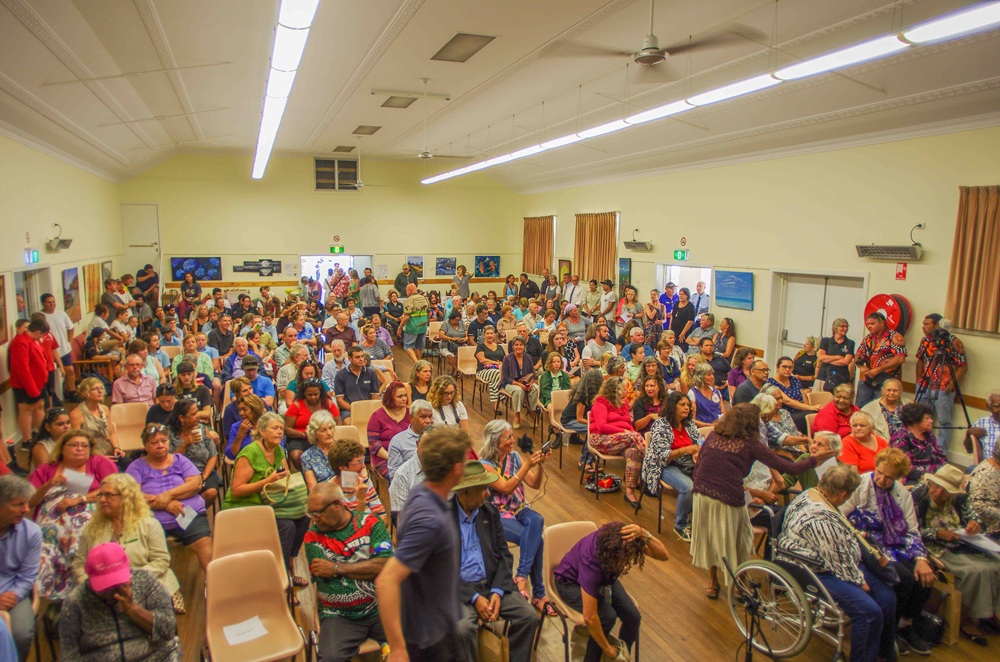
2017 joint book launch of the “Gumbaynggirr Dictionary–Grammar 2e” and “Gumbaynggirr Dreaming Story Collection” at Nambucca Community and Arts Centre. Standing room only! Please note the image may include some people who have passed away. Copyright Muurrbay.
Back in 1986, the Gumbaynggir Language and Culture Group came together at a Catholic church in Sherwood, near Kempsey, New South Wales. Gumbaynggirr Elders like Aunty Maggie Morris and Uncle Pop Pacey had been forcibly moved to Dhanggati Country earlier in their lives and now realised there were few fluent Gumbaynggirr Language speakers remaining. They passionately wanted to pass their Language on to younger generations. The Elders enlisted Brother Steve Morelli to help preserve the Gumbaynggirr Language and pooled their pension money for the cause.
This collaboration led to transcribing, studying and translating the stories of Uncle Harry Buchanan, in turn feeding Muurrbay’s first Gumbaynggirr dictionary–grammar (soon in its third edition). The group began teaching Gumbaynggirr in that same church, and by 1994, they were calling themselves the Muurrbay Aboriginal Language Centre. That year, Muurrbay published its first picture book, Bamay Possum’s Party. It has pencil drawings, a warm wash on the cover, and a CD of Muurrbay folk performing the story as a play.
In 1996, the Aboriginal and Torres Strait Islander Commission (ATSIC) bought the old reserve church on Bellwood Road, Nambucca Heads, on behalf of Muurrbay. The organisation established its present-day office there and came full circle to its Gumbaynggirr roots.

The church on Bellwood Road, Nambucca Heads, where the organisation moved.
Now led by CEO Uncle Ken Walker, by 1997, Muurrbay was both teaching and publishing in Gumbaynggirr. It was also developing quite the reputation for its success in recording, sharing and strengthening Gumbaynggirr Language. Vital contributors included Aunty Shaa Smith, musician and teacher Dallas Walker, Aunty Pauline Hooler (still a board member), and then–Language researcher Uncle Gary Williams – co-author of this article, later Muurrbay CEO on Uncle Ken’s passing, and now Elder in Residence. (There are many more valued collaborators, of course, and Muurrbay’s rich history deserves to be published in full.)
In 2004, Muurrbay was asked by ATSIC to oversee a regional language centre. Could it use its experience to support all seven Languages spoken between the Hawkesbury and Tweed rivers? (These are Bundjalung, Yaygirr, Gumbaynggirr, Dhanggati, Gathang, Wanarruwa and Awabakal, and Darkinyung.) Proposed priorities included Language research, dictionary production and developing adult Language courses. Muurrbay’s other Language groups recognised the significance and value of the Gumbaynggirr dictionary–grammar. A two-day Elders’ Council that same year brought together representatives of each of these seven Language groups, who decided which Community among them most needed a dictionary–grammar – quite different from editorial meetings we might be used to!
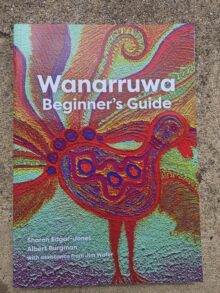
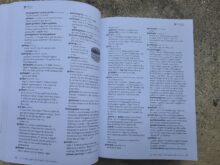
This is why Muurrbay then published a historical grammar for the area around the Hunter River–Lake Macquarie (now more commonly termed Wanarruwa or Awabakal, depending on the area), followed by dictionary–grammars for Dhanggati, Darkinyung, Gathang and Yaygirr, in that order. An online dictionary was created for Bundjalung–Yugambeh because of its multiple dialects. Muurrbay Language worker Aunty Sharon Edgar-Jones, together with two non-Indigenous linguists, also devised the extremely useful Wanarruwa Beginner’s Guide to bring one of her Languages closer to its Community.
In a research interview with Jodie in April 2025, Christine Bruderlin – book designer of choice for Muurrbay and countless Aboriginal-led organisations over three decades – highlighted these dictionaries as one of Muurrbay’s great successes. In company with respected presses like IAD Press and the Aboriginal Studies Press, Bruderlin noted the organisation has “got one of the biggest dictionary lists in Australia, really – so that’s an achievement”.
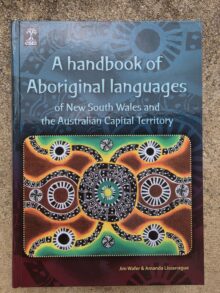
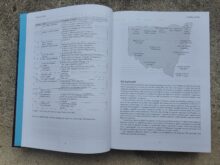
But Muurrbay hasn’t just focused on dictionaries. In 2008, it published the labour-of-love tome A Handbook of Aboriginal Languages of New South Wales and the Australian Capital Territory, which belongs in libraries around Australia, not just in New South Wales and the Australian Capital Territory. Teaching resources have been published for Gumbaynggirr (the three-part Barriyala/Let’s Work series) – a default resource in children’s and adult Gumbaynggirr classes across the Country – as well as Languages Muurrbay has taught at vocational certificate level (Gathang, Gumbaynggirr, Wanarruwa).
Muurrbay has also re-issued a memoir by Gumbaynggirr Elder Aunty Jessie Williams, plus various children’s books (look out for new editions of Bamay Possum’s Party and Dulaybam Dunggiirr – forthcoming). But books aren’t its only publications. The language centre has also created a DVD that shares Stories from a Bundjalung Wahlubal Speaker: Poppy Harry Mundine Walker and another of animated Gathang stories. The wordless resource Mayalambala included three posters of scenes to set conversation in any Language, as well as images of characters, animals and objects. And, in collaboration with Living Languages, Muurrbay has released Who, What, Where? card-and-poster sets in a range of sizes, which can likewise assist learners of any Aboriginal Language.
From Jodie’s research on Gumbaynggirr and Warrimay Country in 2025, Muurrbay’s books and materials are present in classrooms, museums, bookshops, libraries, schools and Aboriginal Cultural organisations. Muurrbay’s impressive output has also just been incorporated into the AustLit database, and the organisation was invited to participate in June’s Bellingen Readers & Writers Festival. Uncle Gary Williams was mainstage for the Welcome to Culture event, and three Muurrbay stalwarts – Uncle Gary, Brother Steve and board member Uncle Micklo Jarrett – had the Fringe audience in song and stitches talking about the organisation’s history.
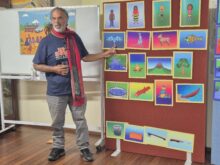
Uncle Micklo Jarrett teaching a Gumbaynggirr class at Muurrbay, using Muurrbay’s own “Who, What, Where?” teaching resource. Copyright: Muurrbay.
Muurrbay’s publishing – and the ecosystem that has emerged
Beyond its own published materials, Muurrbay has also seeded a publishing ecosystem in the Gumbaynggirr Language, as well as in other Languages it supports.
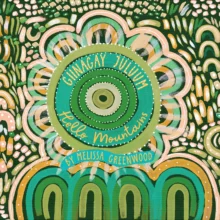
Gumbaynggirr, Bundjalung and Dunghutti woman Melissa Greenwood, besides running the fashion label Miimi & Jiinda, is also the author/illustrator of several picture books published by ABC Books. Muurrbay provided the Gumbaynggirr translations of Giinagay Juluum/Hello Mountains, Giinagay Gaagal/Hello Ocean and Miimi and Buwaarr/Mother and Baby. Recognising the organisation’s work, all of Greenwood’s books acknowledge Muurrbay and the Gumbaynggirr Elders “who contributed to the revitalisation of our Gumbaynggirr language and the resources they provide for learning”. For Giinagay Juluum, Greenwood specifically thanks Uncle Gary Williams for “working tirelessly for the community to have access to language”.
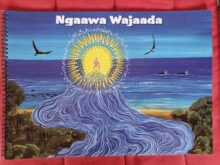
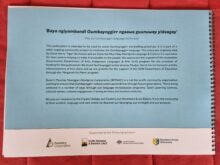
Organisation Bularri Muurlay Nyanggan Aboriginal Corporation (BMNAC) has also created a publication using Muurrbay’s work. BMNAC runs a bilingual Gumbaynggirr–English school in Coffs Harbour, the Maam Giingana Gumbaynggirr School. BMNAC published a limited-edition teaching resource, a wordless picture book called Ngaawa Wajaada, “the story of how our languages came to be” (watch BMNAC CEO Clark Webb tell this book’s story in Gumbaynggirr). Ngaawa Wajaada’s back cover notes, “This story was originally told by Uncle Harry ‘Tiger’ Buchanan, and we thank the Muurrbay Aboriginal Language & Culture Co-operative for their work in helping to make it accessible to the people.” Muurrbay published this story in one of its most beautiful books, Gumbaynggirr Yuludarla Jandaygam: Gumbaynggirr Dreaming Story Collection, where you can read it in English.
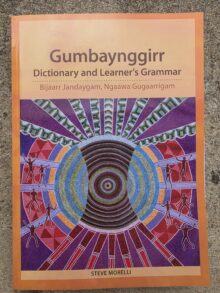
A different legacy of Muurrbay’s endeavours is shown through Yandaarra, a Gumbaynggirr-led research project coordinated by the University of Newcastle. This project has produced two children’s books with Gumbaynggirr Elders, Yildaan: Our Dreaming Track and The Dunggiirr Brothers and the Caring Song of the Whale, both published by Allen & Unwin. Each shares a Dreaming story and some contemporary experiences from Gumbaynggirr Country. The Dunggiirr Brothers is co-written by Aunty Shaa Smith, former chair of the Muurrbay board and the creator of powerful artworks that decorate the organisation’s offices. (This artwork includes an enormous canvas of the white fig tree that gives Muurrbay its name, also shown on the cover of the Gumbaynggirr Dictionary & Learner’s Grammar.) Aunty Shaa is one of several Muurrbay staff members who have taken their skills (publishing and otherwise) from Muurrbay to other Language or Culture organisations.
Other publishing tendrils can be followed to books in Gathang and in Wanarruwa created by Muurrbay staff on their own time, or to publications in Yaygirr-Yaegl or in Gathang (again) that can only exist because of Muurrbay’s dictionary–grammars. For works in other Languages, such as the Guuyata Dhanggati series or Nganhima Dhitiyn! Wanha Nga’ang Nganhimakayi! (both in Dhanggati), Muurrbay has auspiced other organisations so they can access publishing funds.
Evidently, Muurrbay’s own publishing output is being used and valued across its Language Communities; some of this output goes on to make books of their own. But also, the centre should be recognised for the material support and capacity-building that it has extended to other East Coast Language organisations. Muurrbay has encouraged the growth of a Language publishing ecosystem and influenced numerous publications that contribute to vital Language learning and revitalisation in Australia – no small feat for a group that started with a kitty of pension money back in 1986.
Thoughts for the publishing industry
It is wonderful we are in a time when Australian publishing is more attentive, more proactive, in its relationship with Indigenous authors and the Languages of Aboriginal and Torres Strait Islander Peoples. Many more Indigenous authors are sharing their Languages with non-Indigenous readers. Tara June Winch offered Wiradjuri in her Miles Franklin winner The Yield, and Anita Heiss did so in the very title of her novel Bila Yarrudhanggalangdhuray, using her Wiradyuri Language (Heiss’s preferred spelling).
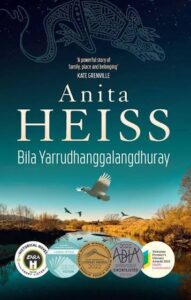
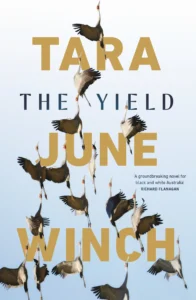
It is important to remember that while some Languages may be “public” (available in print or web dictionaries), they still belong to the Language Community. As one of Jodie’s interviewees in her PhD research explained, “Even though Language is written now and people want to see it and someone’s name is on that book – it still belongs to the People” (“Liza”, July 2025). A Language is part of the Indigenous Cultural and Intellectual Property (ICIP) of each Community, and its use should be determined only by them.
In contrast to the novels above, Kim Scott – a long-time collaborator of the Wirlomin Noongar Language and Stories Project – chose to include only three or four Language words in his multi-award-winning Taboo. As you might remember, this is a novel that intimately explores a Community’s process of reclaiming an Aboriginal Language. Scott explains in his afterword, “There is little literal Noongar in Taboo. I would have it speak to a wider audience and do more than posture difference” (p. 286). Scott made a considered decision, then, to not share his Language.
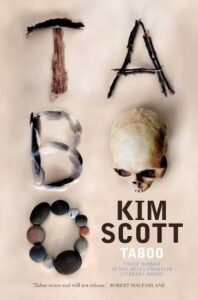
The decision to use or not use an Indigenous Language must be guided by the Community that holds that Language. Muurrbay itself is rigorous in following this practice. That might mean contacting a language centre, or an Elders’ group, or an Indigenous scholar in that Language – and following the pathways and protocols set out for you to seek permission. It will take time, longer than you might plan for. But it is vital to engage the right way, the relational way, the way that helps build connections between blackfellas and whitefellas for the greater good.
It will not serve the industry to see another scandal like Jamie Oliver’s children’s novel Billy and the Epic Escape. This title was pulped in 2024 because it contained harmful stereotypes of Aboriginal people and had not been prepared in consultation with any Indigenous advisors. The novel was also sloppy in appropriating and using two distinct and geographically distant Languages, with the main Aboriginal character using both Arrernte and Gamilaraay words although she lived in Mparntwe/Alice Springs. (Gamilaraay is from New South Wales and Queensland.)
A mistress-class in following protocol is provided by Melissa Lucashenko in the author’s note to her historical novel Edenglassie (also a multi-award-winner). Lucashenko has Bundjalung ancestry, but to write a novel of colonial Magandjin/Brisbane meant consulting local Elders on history, Culture and Language. Lucashenko lists the Aboriginal people she spoke to and details who she consulted on which Language. She specifically adds, “Elders and linguists should always be consulted about use of First Nations languages” (p. 304). Non-Indigenous writers and publishers would be extremely wise to follow Lucashenko’s thoughtful – and pointed – example, as Muurrbay has done through its long and fruitful publishing career.
Category: Features