Australian authors recommend
We asked Australian creators to share a recent book they have read and loved – and why.
Eugen Bacon is an African Australian author whose science fiction novel Crimson in Quietus (Meerkat Press) is set within the Sauútiverse, a shared fictional universe created by African and African diaspora writers. In his review for Books+Publishing, Stefen Brazulaitis describes the novel as a “satisfying science fiction hors d’oeuvre” that “challenges conventional ideas about what science fiction can be”.
Eugen Bacon recommends: “I recently read Kathleen Jennings’s Honeyeater (Picador, 2025) and it struck me as one of the most fascinating literary horrors I’ve read. It’s overwhelming in its darkness and waterlogged omens, and the characterisation was as solid as touch. What stood out was the beauty of the text inside all that death and malevolence, and the ending was just as staggering as the book’s opening.”
 Nadine Browne is a Western Australian writer whose debut novel, Gone Guru (Fremantle Press), draws on her experience studying fiction at New York University under Joyce Carol Oates. Books+Publishing reviewer Hannah Cartmel describes the novel as “an enjoyable read, elevated by its memorable characters, literary sensibility and a philosophical undertone”.
Nadine Browne recommends: “The last Australian books that really stayed with me were Kate Rossmanith’s Small Wrongs and Bri Lee’s Eggshell Skull. I read them close together, and they’ve become linked in my mind. Rossmanith’s book is about criminal law and moral culpability, but what it’s really doing is asking how we account for the full, complicated interior life of another person, which is also what fiction tries to do. It made me think deeply about how we are perceived and what we show versus how we really feel and think. Also, how trauma impacts people differently, and that the idea of fairness produces so much unfairness for victims of crime. Lee’s voice is very different, but both books ask similar questions about power, who gets believed, and why. Eggshell Skull made me want to be braver in my own work.”
 Bestselling crime author Tim Ayliffe’s children’s debut Web of Spies (S.I.G.M.A. #1) (Affirm Kids) is a middle-grade novel about a boy whose search for answers about his missing father draws him into a possible spy ring. Books+Publishing reviewer Kirsten Barich describes the novel as “fast-paced and gripping”, praising Ayliffe’s carefully paced revelations and accessible approach to real-world issues.
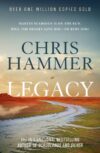
Tim Ayliffe recommends: “There are so many great Australian writers on the scene right now. Chris Hammer’s Legacy (Allen & Unwin) demonstrates why he’s an author at the height of his powers. While he takes us into small-town Australia, he’s always exploring big societal issues involving family, violence and history. Another book I loved was Smother by Eve Thomson (Echo Publishing). It’s a clever legal thriller that explores the impacts of head-knocks on kids playing football, on family dynamics and on fame.”
 John A Scott’s latest novel, The Boy Who Loved Dolls (Puncher & Wattman), is a literary mystery that blends surrealism, film theory, myth and psychological suspense. Books+Publishing reviewer Alex Durac describes the novel as “a work that is as enthralling as it is terrifying”, praising Scott’s ability to weave together philosophical inquiry, art criticism and page-turning suspense.
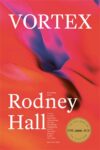
John A Scott recommends: “I read increasingly less these days. My concentration isn’t what it used to be – and neither are my eyes. Having said that, early in 2025 I received a call from Rodney Hall asking whether I would interview him at Woodend Winter Arts about his latest novel, which had recently won the Age Book of the Year Award. At 442 pages (plus 8 pages of notes), it seemed at first a daunting task. I first heard of the book in the mid-to-late 2010s over lunch at Donnini’s restaurant in Carlton. Rodney had only recently launched my novel N, which employed multiple styles, genres and alternative histories, and I was fascinated to hear that Rodney had been working on ‘a book of 101 fragments which could be read in any order’.
When the book was eventually published in 2024 under the title Vortex, I found myself thrown into a constant swirl of timeframes, characters and locations. In many ways, Vortex is an opera of sorts, with choruses drawn from hordes of the dispossessed, their libretti woven from agonised lamentations, their screams and silences in all registers. Or perhaps a Grand Guignol – a blending of horror and comedy; a dramatic entertainment of a sensational or horrific nature, in a sequence of short pieces. Rodney is beyond doubt a master of varying voices (nationality, accent/vocabulary, location), including the capacity to give a ‘voice’ – often terrifyingly – to weather. I was also fascinated by Rodney’s frequent (and daring) use of the abrupt cut.”
 Anna Battese is a Melbourne-based children’s author whose debut middle-grade novel The Grey Beret’s Guide to Surviving the Odds (Simon & Schuster Australia) is the first in a planned trilogy. In her review for Books+Publishing, Clare Millar describes the novel as a “bighearted adventure” that “perfectly fills a gap” for readers aged 8 and over.
Anna Battese recommends: “There are so many incredible Australian kids’ books out there, which makes this question so hard to answer! I’m going to be a terrible cheat and give you my just-read favourites across age groups.
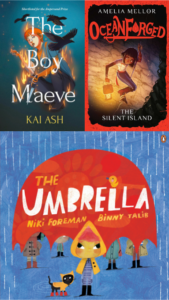
“For picture books, I adored The Umbrella by Niki Foreman and Binny Talib. It’s all about finding where you fit in the world, and it is especially beautiful for neurodivergent kids.
“In middle grade, I just finished and loved The Silent Island (Book 2 in the ‘Oceanforged’ series by Amelia Mellor). Adventures on the high seas, pirates and terrifying sea creatures – all of my favourite things! I also love that Amelia writes fantasy in such an accessible way.
“For YA, I’ve just started reading The Boy Maeve by Kai Ash. I love dark mythology with a bit of mystery thrown in, especially when it’s woven into the real world.
“Actually, now that I think about it, maybe what I loved about all of these books is how they explore belonging – to yourself and to the family you find along the way.”
 Kate Foster is a Gold Coast–based, bestselling and award-winning children’s author whose latest middle-grade novel in verse, A River I Must Be (HarperCollins Publishers), follows an autistic year 7 student as she navigates a new school that struggles to understand and accommodate her needs. In their review for Books+Publishing, George Banach-Salas describes the book as a “strong portrayal of a neurodivergent mind and the importance of inclusion and understanding”.
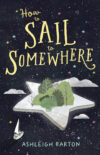
Kate Foster recommends: “One book I can’t get out of my head, which I read last year, is How to Sail to Somewhere by Ashleigh Barton. Ashleigh writes in such a tender, accessible and truthful way, and is fast becoming one of my favourite authors. The book touched a little piece of my soul.”
 Chris Ames is a Melbourne-based writer originally from California whose debut short story collection, I Made This Just for You (Ultimo Press), was already generating attention before publication, having won the 2025 Victorian Premier’s Literary Award for an Unpublished Manuscript. Books+Publishing reviewer Sonia Nair hails the collection as an “astonishing debut”, praising its “wickedly sardonic, frenetic energy” as it skewers the absurdities of contemporary life.
Chris Ames recommends: “Why We Are Here by Briohny Doyle. It’s technically about the heaviest material possible – an honest look at grief during the pandemic – yet due to the skill and humour of the author, it manages to read like a sea breeze. Doyle does this brilliant thing of interrupting the novel we’re currently reading with the one she feels like she should be writing. I read it in a day and have thought about it every day since. Also, I just started The Ruiners by Ellena Savage, and am loving it so far.”
 In The End of Romance, Finnish Australian author Maria Takolander imagines a dystopian world in which boys are conscripted to the army at 16, never to return.
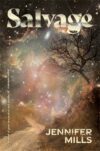
Maria Takolander recommends: “Jennifer Mills’s Salvage (Picador) is a clear-eyed imagining of a climate-ravaged future and of the self-destructive dream of autonomy – the idea that we can be independent of an Earth we depend on for everything. It’s a stunning novel: visionary and profoundly humane.”
 Jessy Wu is a Sydney-based writer and entrepreneur whose debut novel, Good Intentions (Macmillan), is a fast-paced millennial romance set in the worlds of investigative journalism and futures trading. Books+Publishing reviewer Alida Galati describes it as a “compelling page-turner” that captures “the enduring power of first love” alongside the moral complexities facing ambitious young professionals.
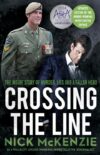
Jessy Wu recommends: “I joke that Nick McKenzie’s Crossing the Line (Hachette) is the unofficial companion text to Good Intentions. McKenzie is one of Australia’s most decorated – and I think most courageous – investigative journalists, perhaps best known for bringing Ben Roberts-Smith’s alleged war crimes in Afghanistan to light. The book is a deeply personal and reflective account of the cost of truth-telling: the powerful forces that coordinate to prevent the truth being told, the toll on journalists and their sources, and what it takes to persist. I read it while writing Good Intentions and am re-reading it now in light of Roberts-Smith’s recent arrest.”
 Mary Colussi is a Sydney-based writer whose debut novel, Touch Grass, won the 2025 Penguin Literary Prize. Books+Publishing reviewer Danielle Bagnato describes it as a “clever and incisive story that holds a mirror up to our era of social media and distorted reality”.
Mary Colussi recommends: “Rapture by Emily Maguire is so very brilliant. I find people who write historical fiction automatically impressive – the research intimidates me, let alone the writing itself, but the ninth century? I have no idea what the ninth century looked like! Well, I didn’t, until I read Rapture. Another thing I admired: I’m not a religious person, but I felt through reading this that I got a sense of what it means for people to have a deep, philosophical and quite literally transformative connection with their faith. That’s a real gift, to peek behind the curtain of someone’s heart like that.”
Category: Think Australian feature